
Winter 1522
It was midmorning by the time Iñigo and Lucas crested the hill on the hedged countryside to lay eyes upon Logroño. It was a walled city by the looks of it, built with a red granite that shown on the eastern walls and towers in the morning sun. The city was clearly designed to anticipate sieges back in the long years of the crusades, when frequent conquests and reconquests were ever apparent in the battle for Iberia. A river called Ebro acted a natural barrier upon the northern stretch of the town. The Twelve Arches Bridge stretched from Ebro’s northern to souther banks, it granted the sole access to the city from the northern Camino de Francés road.
Iñigo and Lucas, looking just two hundred yards down the hill to the near side of Ebro, saw the hermitage of San Juan de Ortega. It lied on the left side of the present road, at an intersection of roads which stretched far to the east to west along the bank of the river. San Juan de Ortega was a simple hermitage, with its mission style front façade facing west. It was built in the triangular romanesque style with a small bell lying at its center point.
“I wish I had known I was so close before making camp yesterday.” Lucas pondered as he reach toward his lower back to loosen its soreness.
Just beyond the far southern bank of the river was the more prominent bronze bell and tower of the Iglesia de San Bartolomé, the one which had caught the glistening eye of Lucas earlier as it peered above the hedged hill. Four more prominent towers were scattered across the main city center within the walls. The closest two were castle towers which sat on the southern bank on the far side of the bridge across the river. They served as the garrison and entry point into Logroño’s northern walls.
"Little Jerusalem" Iñigo whispered, wondering perhaps what it would look like to one day look upon the Holy City.
It was not too much longer that Iñigo hoped to lay eyes upon the Holy Land. However, when that day would come he would see that Jerusalem sat fortified on a high bank. Here, however, Logroño sat in a valley stretched across a plain. A large plateau lied just to its northeast and mountains stretched to a point in the far southeast. They beamed a soft brownish green on the chilly winter morning.
“Francis, show me the way.” Iñigo whispered again, with a hopeful obedience.
The two other towers noticeably seen within Logroño’s walls were also churches like San Bartolomé. One was the pointed gothic tower of the Imperial Church of Santa María de Palacio. It sat just to the west of the two castle towers and San Bartolomé, nestled somewhere off a street in between the two. The original church of Santa María La Vieja, "Saint Mary the Old" sat just in the shadow of the spire of the Imperial Church within its palace walls.
The final tower of Logroño, was similar in romanesque style to San Bartolomé. It stretched to its height on the farther western horizon, near the city center. Santa María La Redonda, “St. Mary the Round,” the church was called for its circular bodied design. It was as the official church of the bishop's palace, which sat in a proper rectangular Spanish quarter attached to the Church.
As soon as Iñigo and Lucas passed the hermitage of San Juan de Ortega, with the bridgeway in front of their periphery stretching its arms into the city, the day’s beginning began to take form. Then came the first symphony:
"Ding, Ding, Ding . . . Ding, Ding, Ding . . . Ding, Ding, Ding."
"Dong, Dong, Dong . . . Dong, Dong, Dong . . . Dong, Dong, Dong."
The simplicity of Juan de Ortega’s hermitage bell rang at their side as the three other larger church towers, in response, bellowed and echoed through the narrow corners of the city.
"Ahh . . . Jericho" Iñigo whispered this time, recalling the ancient story of the walled city and Joshua’s trumpet procession.
“The first city promised” Suddenly more clarity had filled Iñigo’s mind.
A mellow and tempered friar, dusty, with a shaved head, clean face, and wrinkles on his forehead and under his eyes; rounded the far side of Juan de Ortega to open its doors.
He turned briefly to look upon the two strange riders, only to then briefly raise his hand with a simple gestur, waving as Lucas and Iñigo passed by. Iñigo offered a gentleman's nod to the man. Lucas followed suit.
"We've but an hour till La Misa." Inigo, turning to Lucas, gestured as he determinedly prompted his horse forward.
Lucas's rouncey followed behind in line as they stepped on the first arch of the bridgeway.
"Eleven to go," Lucas nervously mumbled to himself. The gated wall of the city lay ahead.
Into the belly's deep, the men crossed the Ebro. Its current glimmered in the clear barren sky on the thorn bit winter-chilled morning. Ebro’s waters were a deep steel cut cold blue, and seemed to pierce as eyes right through the tightened chest of Lucas.
As they made their way to the bronze bells of San Bartolomé, the red banners, bristling in the soft wind off the windows of the two castle towers, were now ten arches before them.
If Lucas were to have looked again into Iñigo’s brown eyes, as he did on the road earlier, he would have seen a similar red bannered fire raging down into the depths of the man’s soul. Iñigo’s knee ached from the long journey in the saddle. But his resolve was unwavering.
"Renewed strength is coming soon." Iñigo whispered to himself. "Into these depth's, the Lord's kingdom awaits."
. . .
10:00 - San Bartolomé
“Circumdedérunt me gémitus mortis, dolóres inférmi circumdedérunt me: et in tribulatióne me invocávi Dóminum, et exaudívit de templo sancto suo vocem meam.”
The words in Latin came like a sudden crack upon Lucas’s chest from the front of the sanctuary.
“The terrors of death surround me, the pains of the nether world surround me: in my tribulation I called upon the Lord; from His holy temple He heard my voice.”
Lucas, grateful for his mother's lessons in Latin, stood as firm as a soldier ready for orders in the nave of San Bartolomé. His father's wool cloak he folded and placed by the red granite walls of the interior, under the station of the cross where Christ consoled the women weeping. There too he rested his bow, the arrows and quiver he left back with the horse in his saddle bag. Inside the Church, Lucas now came to see how tattered he actually looked in his inner clothing without the guise of his camouflaged attire, the means of which had brought him through French lines of thirty thousand men to this very Church filled with thirty Iberians on this February morning.
“Díligam te, Dómine, fortitúdo me: Dóminus firmaméntum meum, et refúgium meum, et liberátor meus . . .”
“I will love You, O Lord, my strength: The Lord is my firmament, and my refuge, and my liberator . . .”
Purple satin and white linen adorned the man up in front, wisps of cold air poured off his lips as a fireplace warmed the nave from Lucas's backside, The draftiness of the church was evident amidst its vaulted ceilings. The upper sanctuary and altar had yet to fully warm.
Despite the cold, the priest stood erect after he brought himself off his knees. Turning back towards the east, a humble silence filled the room as some began to sit, others knelt, and a few wondered about and thumbed through prayers in the side sanctuaries.
The thoughts of his companions in Lourdes, came back now to his mind. “Remember us in your prayers at La Misa” were the last word his superior left him with.
It had been a while since Lucas had been to La Misa, really since that Christmas day in Lourdes, and even back then his mind was fixed on the pending adventure ahead and the pressing sorrow of his mother.
“I will do whatever I can to put her trainings and schooling to good use. I won’t forget her, her character, her love. I will prove her proud as her son.” The blurring thoughts and clashes of a lifetime full of stories and moments rushed through his mind at that Christmas morning Mass.
“He couldn’t forget her, he mustn’t forget her face or her voice, he must practice his French, and remember the countless lessons.”
. . .
The journey through the Pyrenees really was about much more than a journey home, Lucas had now come to realize. In a way, it was a final a search for his mother, a final seeking of her ArgonesePyrenees childhood, a final culmination and chance to practice of all that she had taught him as a son.
And here now Lucas found himself once again in a church not to unlike Santa María La Real, the one his mother and those boys had helped build back in Aranda de Duero. Still though, he could feel the pressing fear, not a corner of his memories were unmarked by the largeness of her life.
Almost instinctively now, like a desperate son, he turned his head once again to Iñigo.
Iñigo's eyes, were fixed forward, beyond the priest up front. He was leaning to the far left on his cane, The vast array of the golden altar and its statues lied above and beyond the priest. But even more, Iñigo’s eyes seemed to not fix on a particular statue or candle, but rather seemed to see beyond them into some greater thought of meaning.
Lucas, again tried to remember the man’s advice on the road:
“Keep your nose and eyes in front of you . . . Don't lose sight of simplicity.”
“Listen and follow,” were the words which now seemed to rest upon Lucas mind. He knew not where they came from. Yet, he got a feeling their advice would ring true:
. . .
“Preces pópuli tui, quæsumus, Dómine, cleménter exáudi: ut, qui juste pro peccátis nostris affligimur, pro tui nóminis glória misericórditer liberémur.”
“Graciously hear, we beseech You of Lord, the prayer of Your people, that we, who are justly afflicted for our sins, may for the glory of Your name be mercifully delivered . . .”
Lucas proceeded to bow his head,
“Deliver me, O Lord” he mumbled under his breath, a tear, the first since the riverside cave, had finally once again filled his dried eyes and trickled down his cold and chalky face.
. . .
“De profúndis clamávi ad te, Dómine: Dómine, exáudi vocem meum. Fiant aures intendéntes in oratiónem servi tui . . .”
“Out of the Depths I have cried to You, O Lord: Lord hear my voice. Let Your ears be attentive to the prayer of Your servant . . .”
The prayers kept hammering upon Lucas’s chest, wearing down the thickness beneath his tattered clothes.
“Why did you take her from me?” Lucas let out the plea.
“Have I not served you, and loved you from my youth? Have I not gone to the edge of my country for your glory? What more must you ask of me and my family?”
The desperate questions followed.
Then came the readings, “Friend, I do you no wrong, did you not agree with me for a denarius? Take what is yours and go your way. I will also give to the last even as I gave to you. Or is it not lawful for me to do what I will? Is your eye evil because I am good? So shall the last be first, and the first last. For many are called, but few chosen.”
“I do you no wrong . . . what I will . . . good . . . called . . . chosen . . .” The words kept spinning.
“O Lord, help me to understand. Help me to find peace.” Lucas kept pleading.
. . .
“Bonum est confitéri Domino, et psállere nómini tuo, Altissime.”
“It is good to give praise to the Lord, and to sing Your name, O Most High.”
“How can I praise you when so much is in disarray? Why, O Lord? How did it happen? I am so close to answers, yet they feel so far away.”
. . .
“Munéribus nostris, quæsumus, Dómine, precibúsque suscéptis: et cœléstibus nos munda mustériis, et cleménter exáudi. Per Dóminum . . . “
"Receive our offerings and prayers, we beseech You, O Lord, and by these heavenly Mysteries both cleanse us and graciously hear us. Through Our Lord Jesus Christ . . .”
“Please O Lord, help me to see, give me clarity.”
. . .
“Hoc est enim Corpus meum . . .”
“For this is my Body . . .”
. . .
“Hic est enim Calix Sánguinis mei . . .”
“For this is the Chalice of my Blood . . .”
. . .
“Memento étiam, Dómine, famulórum familarúmque tuárum, . . . qui nos præcessérunt cum signo fidei, et dórmient in somno pacis . . . “
“Remember also, O Lord, Your servants and handmaids, . . . who have gone before us with the sign of faith, and rest in the sleep of peace . . .”
. . .
“Ficas, bene, dícis, et præstas nobis.”
“Bless, and bestow upon us all good things.”
. . .
"Libera nos a malo.”
“Deliver us from evil.”
. . .
“Da propítius pacem in diébus nostris . . .”
“Grant of your goodness, peace in our days . . .”
. . .
“Pax Dómini sit semper vo bíscum.”
“May the peace of the Lord be always with you.”
. . .
Suddenly a small Pax was carried throughout the nave by one the the vested children. As the server stretched out his small arms with one of his hand gripping the back handle of the the tablet. and the other holding its bottom, each of the thirty-some in the room had a chance to respond with kiss of peace on the tablet. As it rounded its way around the nave, it was then was presented to Lucas. Upon seeing the Pax, Lucas noted the bronze table and image before him. The tablet was engraved with an ornate frame. At the bottom was a crested shield of the House of Mendoza, whose family ties originated from a town just a days journey to their north. Oat the top was the marked sign of the Camino de Santiago, a seashell, to remind pilgrims of the many roads which led to Santiago de Compostella. One of which they found themselves on this morning. The main part of the tablet though was what gripped Lucas’s mind. It was the central bronze engraved image, one of Christ’s mother holding him after he was taken down from the cross.
La Pieta is what the Romans called it. St. John and Mary Magdalene were flanked on each side. The cross itself lied empty, but the body of Christ, held in his mother’s arms, was warped and dangling from left to right. His ribs and muscles spoke of emptiness, a draining. There was hardly much left of his body, as he lay mangled and dead. Then came the words once again,
“Will you show Me peace O, Lucas? Will you show me honor by how I have loved you?”
Another tear filled Lucas’s eyes. And then came a gradual kiss on the bronzed body of Christ.
“Peace be with you, my Lord.” Lucas then replied.
As he looked at the Pax then came another word,
“Will you console now my mother, will you let her now be yours?”
Lucas looked now to the sorrowed bronze face of Christ’s mother.
“She knows the sting of death too.” Lucas realized.
Leaning once again towards the tablet was all he had to do. There was need for no other reply.
12:00 - The Inn
As the walked out of the warmth and under the arched portal of San Bartolomé, a sudden quiet rest upon both the men in the shadow of the towered church outside. After checking on the horses, and reorganizing their supplies, Iñigo and Lucas found their way to a local inn around the corner from San Bartolomé for a quick travelers lunch.
They crouched through a weathered doorway into a inner chamber with tables and chairs set throughout. The chillness of the February air was still noticeably seeping through the walls of the inn. Lucas wrapped himself in the ashen covered woolen brown cloak of his father. Inigo, still dressed in nobleman's attire, had with him his cape. Grabbing it out of his saddle bag before they entered the inn, now, he draped it across his shoulder as they approached a door and side alcove within the inner dining quarters. The cane of Inigo, knocked steadily on the wooden floors as the men in both their leather boots walked within.
Off to their left they found a little granite room, a nook filled with stone quarried likely from the same region as the church. It held within its quarters a coziness that was oft unrecognized over the past couple of months for Lucas. Its entrance door, framed with large granite rocks and mortar, was about two feet thick. It had on its top a simple wooden beam, just as thick in depth as the walls but long enough to hang just over the three foot width of the door.
Likely, it was a stylistic piece of wood, used to accent the space above the room, but also it served the double purpose of providing a support to the the four feet of stones which lied above its frame. The room itself was perhaps ten feet in depth, fifteen feet wide, and ten feet tall. Large enough to fit four high top tables with two chairs at each.
On the far wall’s side, ten feet from the door frame, stood two of the tables flanking a framed window at their center with a matching wooded beam framing its top. When one would sit on the left, looking beyond through the window, the angle was such that the street and façade of San Bartolomé stood perfectly within view across a garden to the southeast. This is the seat Lucas had chosen. Facing the the door to his right, with the mass of a plain reddish gray stoned walls in his front periphery. The table on the left flank of the window sat in such a manner that Lucas’s back was pressed only against to the wall farthest from the door.
Iñigo proudly took the chair to the right of the table, the one facing Lucas. Nothing was in his purview but the cloaked young man in front of him. Unlike a soldier, he sat with his back to the door, as if any oncoming fight was unimportant to his fixed focus ahead. His sword remained sheathed on his lift side. Lucas’s bow sat against the back wall, alongside it now was his quiver resting at the foot of his chair to his right
“Perhaps, he thinks I will have the door covered." Lucas thought as the man limped into the high top chair. Only slightly over five feet tall, the chair seemed to increase the stature of Iñigo who Lucas noted had already seemed to hold the inner room on the edge of knife.
Uncomfortably, Lucas looked up at the wooden ceiling which served as a floor to the inn rooms above. Framed perpendicular to the door, ten wooden beams were drawn about a with about a foot and half spacing across the fifteen foot expanse. The wooden boards of the floor above were laid flat across the supported expanse.
"So a soldier you are . . . and business ahead?" Iñigo fixing his gaze on Lucas, gestured the conversation forward.
The innkeeper brought out bread and bowls of legume and chicken stew, their first meal of the day after the morning Mass. The innkeeper, after a couple more questions and Iñigo’s gratuity, promptly left them to their meals.
Now, Lucas was the one weighing and calculating. He measured his response as a stillness and timeliness fell upon the cozy winter drawn granite room.
The tower of the San Bartolomé glared before him in the window to his left. The cannonball hole, shot into the stony façade of San Bartolomé from a momentary French siege of the town just a month earlier, glared and stared at him.
“Well, I guess I've been cornered and caught.”
Then, in a instant, and much to Lucas’s surprise, the even stonier façade began to loosen as his tightened facial muscles relaxed. The young man, now wearied and caught, was letting down his guard.
Just how Iñigo, who was now smirking cheek to cheek, had thought.
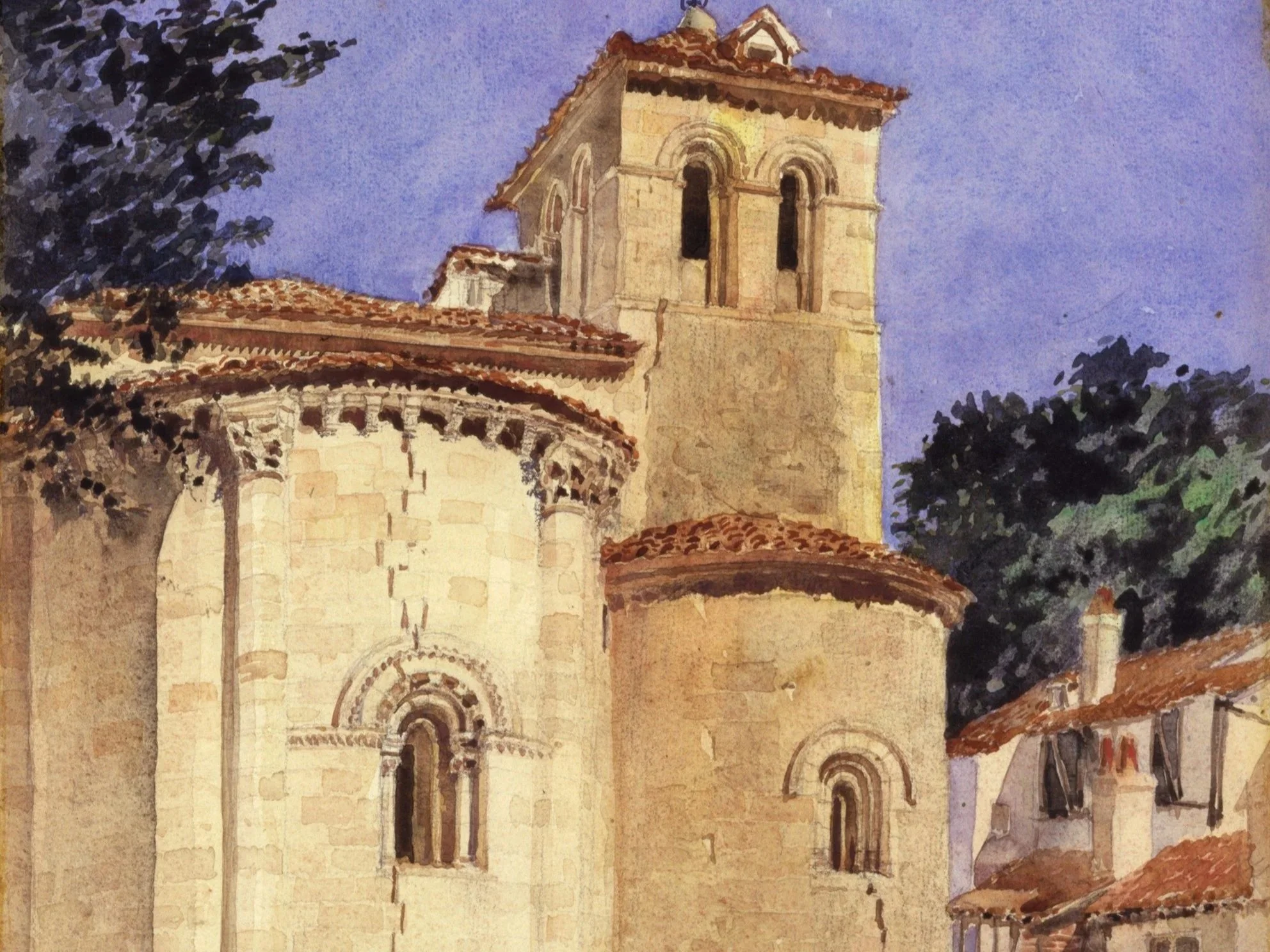
Cass Gilbert / Church at Segovia, Spain / 1920 / Watercolor / Wikimedia Commons / Public Domain